Monday, July 09, 2007

The Tropics of New York


The Tropics of New York
by Claude McKay


Bananas ripe and green, and ginger root
Cocoa in pods and alligator pears,
And tangerines and mangoes and grape fruit,
Fit for the highest prize at parish fairs,

Sat in the window, bringing memories
of fruit-trees laden by low-singing rills,
And dewy dawns, and mystical skies
In benediction over nun-like hills.

My eyes grow dim, and I could no more gaze;
A wave of longing through my body swept,
And, hungry for the old, familiar ways
I turned aside and bowed my head and wept.


The Archives of Claude McKay, Carl Cowl, Administrator

Thursday, May 03, 2007

T'ang Yin


T'ang Yin
Secluded Fishermen on an Autumn River
Inscription by a friend dated 1523
Section of a handscroll
Ink and colors on silk (h. 11-1/2 inches)
Palace Museum Collection, Taichung

"His beginnings were brilliant; he took first place twice in provincial examinations, the first time when he was only fifteen years old. Su-chou scholarly society befriended and supported him, and at the age of twenty-eight he set off for the capital with high hopes, to take the state examination that was the entrance to a career as a government official. Again he passed in first place; but it was later disclosed that a playboy friend had bribed the servant of the examiner to get advance information of the essay subjects; T'ang Yin was involved in the ensuing scandal, and degraded. Finding himself thus barred from the standard vocation of the literatus, and, unlike Wen Cheng-ming and others, too poor to live in elegant retirement on private means, he settled into an in-between existence, selling paintings when he needed money, forgetting the bitterness of his disgrace in the taverns and pleasure quarters of Su-chou one day, transcending it through Ch'an Buddhism meditation the next. Throughout all this he kept the friendship of that paragon of virtue Wen Cheng-ming, who admonished him in vain for his profligacy."

James Cahill, Chinese Painting (Geneva: Albert Skira, 1960)

Sunday, April 29, 2007

Wild Geese Descending on the Sandbank


(from a Sung Dynasty painting)

Mei Ri-qiang (b. 1929)
Guangling Qin Music (Volume 6)
(Hugo cd 7144-2)
Wild Geese Descending on the Sandbank

From the album notes, "A Descriptive Prose on Listening to Mei Ri-qiang's Qin Playing, by Dong Xin-bin (transcribed as translated and printed):

Mei Ri-qiang, alternative name Nan Yi, is a hermit who withdrew from society and also a great Qin master of the refined style.

Mei never scrambled for power, but worked throughout his life. Although he faces a lot of narrow views and villains, he is wise and healthy in mind. He is a great man who lives among the common people. He is an unusual person--generous and open-minded--of the time.

Mei has a close friend--the Qin. For 60 years, he played it and reached the highest level of Qin study. His style of study is "tolerant and gentle, and never discusses an insignificant problem. He could never be compared with those who want to please the people in power or thos who ingratiate themselves."

If sound is correct, music would be deep. If the music is deep, the notes would inevitably be harmonious. So good and harmonious music is originated by involving heaven and earth, it shows good sense and it conforms to the mystery of the universe.

Tuesday, April 10, 2007

And beyond...


This week's special... Saw a man at the 7-eleven counter this morning, middle-years, portly, maybe from somewhere in South Asia. He looked like someone's unce, with a good haircut and woolen trousers...until I noticed the small revolver tucked into a holster--well-oiled--on the right side of his belt. A jeweler, perhaps?

Story from Shelley Winters, in Los Angeles during the war years. Close with Bertolt Brecht, she once invited him to her mother's home for dinner. Long afterward, her mother asked about "...that fellow in the jewelry business you once invited here." "Jeweler? I don't remember anyone like that..." "Oh yes, when I asked him about his work, he told me he made jewels for poor people..."

Sunday, March 11, 2007

Above the River...


From James Wright--Above the River: The Complete Poems. A view of the Ohio, at Martins Ferry. (Photograph by Madeline Zulauf)


AS I STEP OVER A PUDDLE AT THE END OF WINTER, I THINK OF AN ANCIENT CHINESE GOVERNOR

An how can I, born in evil days
And fresh from failure, ask a kindness of Fate?
--Written A.D. 819

Po Chu-i, balding old politician,
What's the use?
I think of you,
Uneasily entering the gorges of the Yang-Tze,
When you were being towed up the rapids
Toward some political job or other
In the city of Chungshou
You made it, I guess,
By dark.

But it is 1960, it is almost spring again,
And the tall rocks of Minneapolis
Build me my own black twilight
Of bamboo ropes and waters.
Where is Yuan Chen, the friend you loved?
Where is the sea, that once solved the whole lonliness
Of the Midwest? Where is Minneapolis? I can see nothing
But the great terrible oak tree darkening with winter.
Did you find the city of isolated men beyond mountains?
Or have you been holding the end of a frayed rope
For a thousand years?

Friday, January 26, 2007

Shuijing in Studio


It was one of those moments, talking with Shuijing, here in graduate school from the capital of China . Always a sense of the distant place she comes from, even as she makes such an earnest effort to communicate. (To make things objective, share in common.) Late afternoon, ninth floor of Wurster Hall, wide bank of windows to the south, looking out over misty winter rooftops of Berkeley and Oakland, backlit by the sun. Beautiful light. Desks still unsettled--not yet inhabited--it's just the beginning of the term. A rucksack, computer gear, pile of books and notes. Shadow opening on concrete wall--the new seismic pour--a burnished gray expanse, maybe four-feet thick, heavily reinforced... and within, another shadow, someone you almost know...

Thursday, January 11, 2007

Oceanside


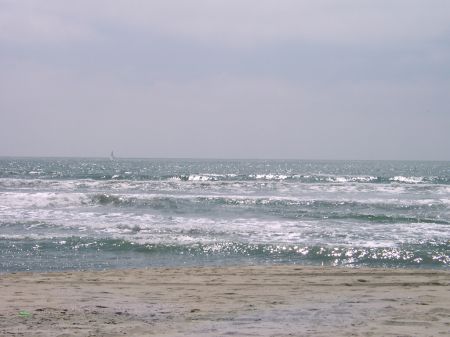
Pounding waves rake the pilings, white foam all across sea. Sand blowing over the road, lapping worn facades of beachfront motels--their Oceanside names--La Siesta--half a century of faded stucco, bleached tile. Not listed on any of the guides, low end-- with off season rates, some boarded up. A single shorebird at lip of incoming wave, rest of beach empty. A soccer ball--blue and white--blowing across the sand, very much on its own. Anomie--or maybe not even that. Marine Corps hair cuts, young guys in uncomfortable civilian clothes--what they've brought from somewhere else. Locals--as chalky as the walls, ungainly face of young boy at Horne and Mission--with his mother, the same features, and his mother's mother too--an ageing girl. His head at an angle, a long box, imagined future containing much of the same...

Sunday, January 07, 2007

Edwin Dickinson


Fairfield Porter on Edwin Dickinson:

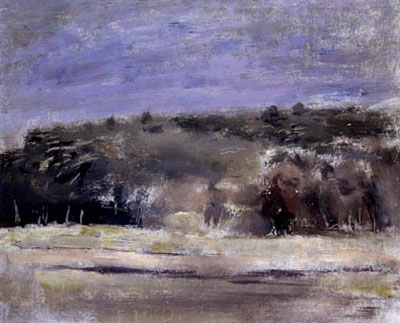
Dickinson makes the most out of the least, especially in Winter Woods, Wellfleet, or View of Green Island. Least is, green, flat ground and blue-green sky; or an impression of trees that gives, with trained simplicity, a single essential for landscape, namely, the presence of nature. In these little paintings, or quick ones, he is in touch with an elusive, and fleeting, essentiality. In his large exhibition pieces, he is in touch with not entirely coordinated ideas of art. In the large paintings, he expresses, like an inadequate classicist, the limitations of a formality that originates outside himself; in the small paintings he has been able to surrender to his deepest self which has a profounder form than the form one can know and understand. It is a form that does not impose itself on his subjects, nor is it outside them. Chekhov said he wrote about the inkwell, and in the same way, in Dickinson’s small paintings, there is none of the manipulation of the artist who has lost contact with himself. (Art in Its Own Terms, p. 118-20.)

Monday, December 18, 2006

Solstice (almost)


From a cold night in December... and now a new year. Bundled up in the studio, as if for a Torino winter, pigeons taking refuge under the eves, a thin layer of ice all across Lake Garda... The town of Riva tucked away at the far end, with her winding narrow streets, snow on all the ledges, and looming just behind, the crags of the Dolomiti...

A single swimming float--from the summer--also with a layer of white...

Pripyat


Reading Martin Cruz Smith--Wolves Eat Dogs--his Chernobyl requiem. Arkady finds himself exiled in the Zone, dosimeter at hand, dodging radiation scarecrows. The 26th of April, 1986--an idiot's experiment gone awry--Reactor Number 4 drops drastically in power, the fuel rods freeze in place, hydrogen gas builds to immense pressure, then explodes, blowing the top off the reactor, taking the core up with it. The call to Moscow--denials that anything is wrong--and word comes back, take some iodine, stay indoors for a day or two... But the May Day celebrations go on as scheduled--children of Kiev on parade--a workers' holiday... Breeze blowing down from the north, thyroid damage immediate, other symptoms take longer...weeks, months, years--a lifetime of regret. Could it have been another way? A black village. Samogon, wormwood...

Monday, December 04, 2006

Angels Camp


Mining country--along old Highway 49. The goldrush towns--Murphy, Volcano, Mokelumne Hill, brick buildings of imported stature, a Boston cornice, Concord arch--sluices and shutes, all still visible along the higher roads, hillsides giving way to slag, now overgrown, buried, waiting to be reclaimed. The color purple--royalty in ancient times, and beyond--maybe the most artificial of tones, never quite red, never quite blue, but fitting, somehow, as a repository of planted hope. Let it grow over, refurbish, return to earth...

Sunday, November 19, 2006

Rhea


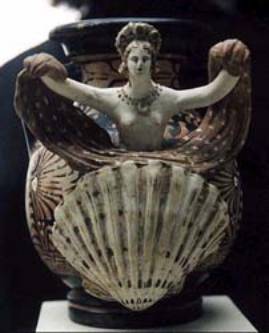
The fullness of her arms, small, delicate breasts--poised above a scallop shell, her shawl revealing the heavens. Arms partially raised, just enough to hold the space, which is regal, like the gesture of the shell itself, both containing and opening at once. Something ancient here, even in the photo, a hand-held camera in some minor Greek museum--the past as if happened upon, re-encountered. That purpose of art--to behold...

Moses, only Moses


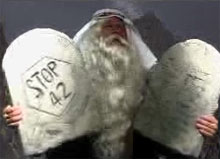
Moses, only Moses--but of course, it isn't Moses. That simulacra of a beard--soft, mid-western yarn--an imitation--and just look at the hands, they're young, too. Where do these things come from? I'm tempted to say, "Don't ask," except that EVERYTHING has already been posted (in the existential sense)--this from someone's political campaign ad, can't recall precisely which one, came up on google--maybe the numbers will tell. Turns out to be in opposition to a minimum wage ammendment to the Colorado State Constitution... This can't be the Moses I know, son-in-law of Jethro, champion of social justice, defender of the people... And yet, and yet, all images up for grabs... There's a u-tube video as well, hilarious-- fake and funny at the same time. "In the mountains of Colorado..."

Charlie Feathers, where are you now?

Thursday, November 09, 2006

Na Wsi


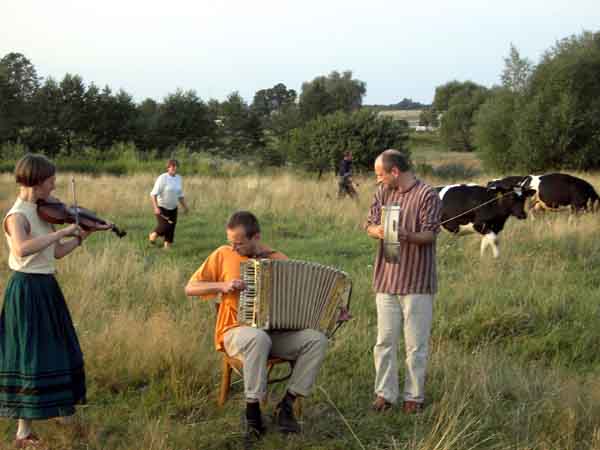
I should really write something about this one, Kasia. In fact, I've been meaning to. Just why it feels--to me, at least--so absolutely Polish. I know that in part it's the off-handedness of everything--music in the countryside, violinist and cows, that ancient accordion, ambiguous figures behind--and a clear sense of late afternoon light. The "student haircut" of the young man seated--his narrow arms, orange shirt--uneven cuffs and scrappy shoes. And then the girl to his right--her narrow build, but taut--the tendons on her neck--and a dark striped skirt straight from Mazowsze... The other fellow alongside, attentive to what's going on--who knows, he might respond in Latin--a medieval madrigal, hand-held drum...

Sunday, October 29, 2006

The Shadow Puppets


Mauricio sent me this photo--found in his desk drawer--from Fowles Street in Oceanside. The Indonesian shadow puppets--they were on that high shelf in my parents' house for as long as I could remember. Dad purchased them at the World's Fair, in New York--maybe 1964, brought them back for us. It was very much the kind of thing he liked to do--a souvenir, yes, but with something of a higher purpose--a part of the wider world, like the cards--many, many of them--that he'd send me from the museums--the Guggenheim, the Modern, the Whitney--modern museums, the ones of today--how these things could become part of our lives, shared that is... Rememeber pondering his choices--Anuszkiewicz, for instance, or Vasarely--"It's what they're doing, son." A great hope in that--the bounty of the ongoing...

Of course, and more recently it was Colin McPhee's book, A House in Bali--with McPhee's own photographs and stories. Read it last spring. McPhee had listened to Balinese music in New York, maybe 1929--the early gamelan recordings--and knew instantly that this would be the rest of his life. An absolute journey of discovery--the past becoming the present, disappearing at the same time. Priceless in its telling...

Also important--the books below, captured incidentally (as with everything). And the shelves themselves, now with me here, holding songs...

Thursday, October 26, 2006

Deux Nues


This fragment from studio notes: "Small Bonnard drawing that I found on line—an etching, used in one of the books. 'Deux Nues.' Forever a reminder—line and touch and smudge."

So elided in the French that at first I didn't recognize the word--nue. More rude in English--the pose as well? But with Bonnard all fluid line, a tentative retouching, built up around the edges--not so much patience as anticipation...a graceful eagerness. Also--always--a sense of the past, the possibility of an earlier time, era of myth--redolent gift. Every woman a goddess--each shop girl a saint...

Tuesday, October 24, 2006

Song


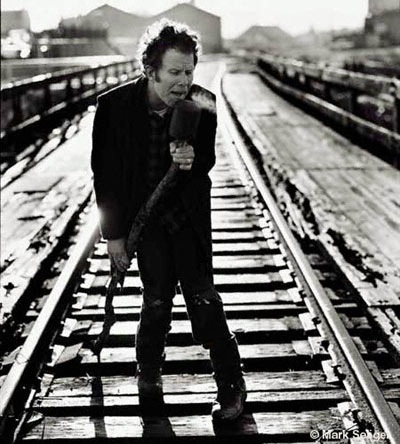
Tom Waits, "Step Right Up..." For one thing, it's not rural, the curve in the railway trestle, with houses behind. Bending forward just so--the anti-hero--a kind of inwardness, even with the snatch of white t-shirt showing--wirey hair, sideburns, furrowed brow. The effort here--one foot turned in, knees almost touching--he holds the microphone (on a railway trestle?) with one hand, fingers relaxed, delicate even. It's only later that you wonder what he's singing--it could be almost anything, but with a road, the distance, that impossible gravel voice...

Le Vieux Carré


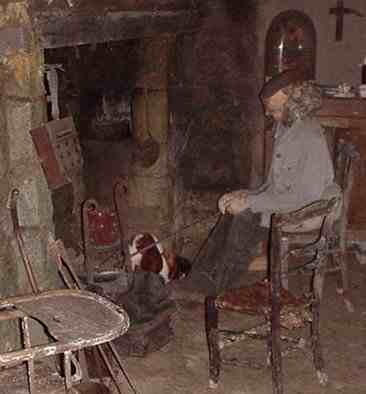
That these images might come from anywhere--like this one, in rural France... Le Vieux Carre. A man in a beret, sitting in front of the hearth, maybe with Alfonse (his old beagle) close alongside. But why the high chair in the foreground? And no fire? Maybe a sculptor's table--everything covered with dust...a clay studio, like the older art student in the hallway at school yesterday evening, elaborate tattoos prominent, on back and neck above a black t-shirt, swatch of clay on her upper arm... And the dried flowers--the ones in the bell jar on the table behind--or is it a votive figure, next to the old cross, like something out of Bernanos... And the man himself, equally unreal--carved full size from life--or is it just the light, the layers of dust, the scattered closeness, the revelations of age...

Sunday, October 22, 2006

Chopin: The Mazurkas


According to the New Grove Dictionary of Music and Musicians, the mazurkas "that remained unaltered by influences of urban music seem to have no definite ending, as the repeats are made ad libitum, or their concluding bar finishes on the dominant on the third beat, without accent leaving the impression of disappearance into the air [...] A certain pride of bearing and sometimes a wildness sharply differentiate (their) mood from that of the more sensuous waltz. The dance has the character of an improvisation…”

“...like handkerchiefs waving on a railway platform when one is leaving everything one loves.” Marcel Schneider (quoted by Olivier Bellamy).

The Little Path


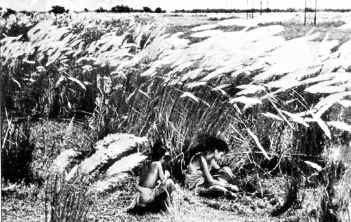
From Satyajit Ray's film, Pather Panchali--The Little Path. The scene here takes place just before the moment when "little Apu and his sister Durga watch with fascination as the first railway train they have seen passes by." Ray made the film in 1955--but it feels as if it were set in an earlier time. (His own childhood?) "In Apu’s youthful mind...the train evokes wonder and amazement, the vaguely humanistic dreams of an indistinctly imagined future of immense possibilities and boundless distances."